

AI has made manually writing complex data pipelines mostly obsolete.
If AI can generate pipelines, DAGs, tests, and even migrations…
What’s left for data engineers to actually work on?
Conceptual knowledge is no longer “nice to have.” It’s the entire job.
In this article, we’ll cover:
How AI is actually impacting data engineering in 2026 (here’s 2025 as a reference)
Which responsibilities are accelerating vs. eroding
How AI coding agents (Cursor, AdaL, Claude Code, Copilot Workspace) change daily work
The design patterns and best practices that now matter more because of AI
A delicious summary infographic at the end
This edition is brought to you by:
DataExpert.io is launching a free Vibe Coding Boot Camp on February 14th and 15th! You’ll get free credits to use AdaL CLI, and we’ll build a fully fledged capstone product together in two days!

How AI impacts data engineering in 2026
The question has shifted from:
“Will AI take data engineering jobs?”
to:
“Which parts of data engineering are now table stakes, and which are still scarce?”
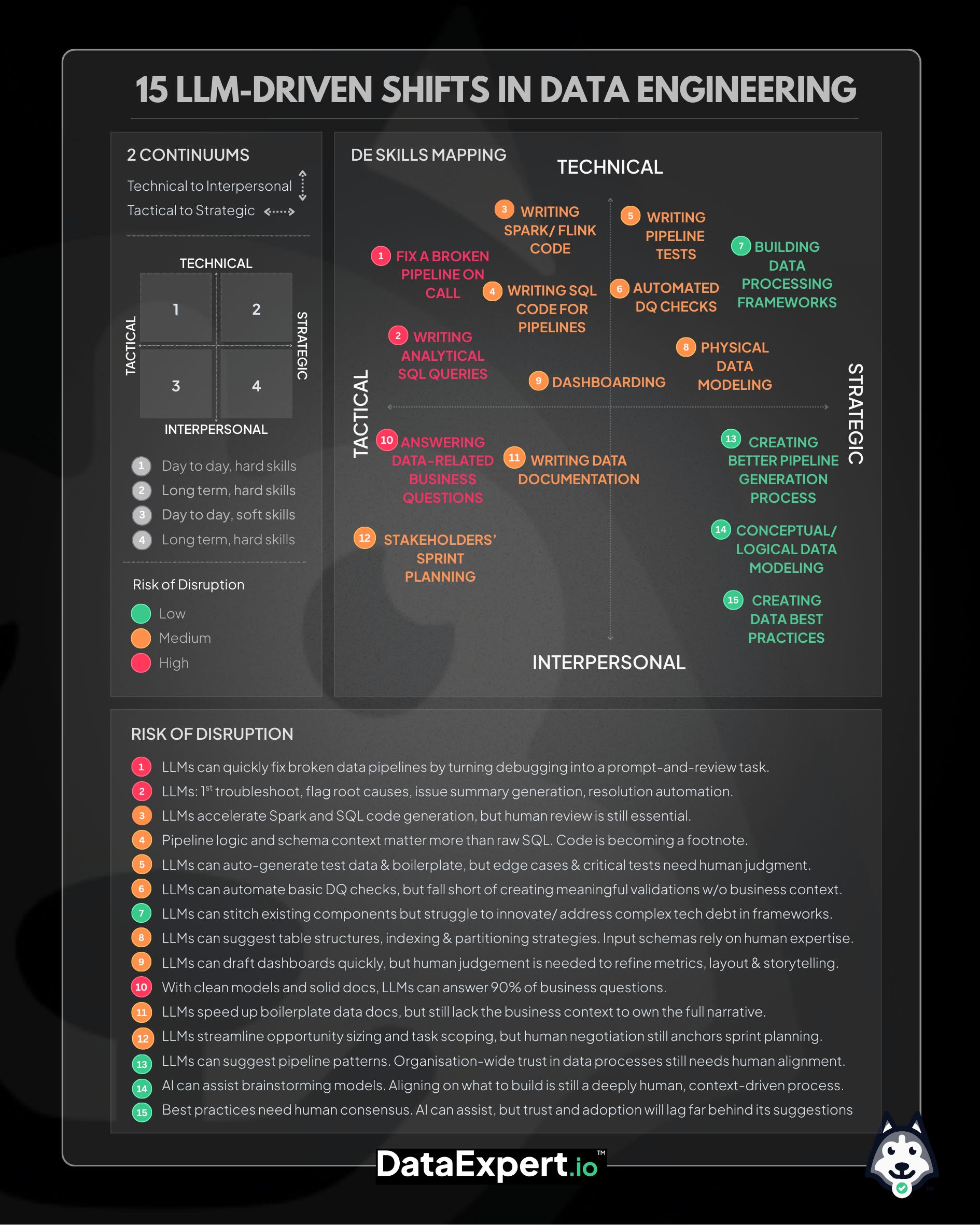
A useful way to think about this is still along four axes (Tactical, Strategic, Soft-skills, Technical). Compared to 2025, some of the risk levels have changed.
Technical + Tactical (short-term, hands-on execution)
Writing Spark / SQL code
High-medium risk of disruption (up from medium in 2025)
In 2026:
AI reliably writes production-grade SQL, Spark, dbt, and Flink code
Most engineers are no longer the fastest code writers in the room
Reviewing, validating, and shaping the code is the real work
If your value was syntax mastery, that value is now commoditized.
Fixing broken on-call pipelines
Very high risk of disruption (up from high in 2025)
Most failures are:
Schema drift
Memory/config issues
Late or duplicated data
Bad quality checks
AI agents are now very good at:
Root-cause classification
Suggesting fixes
Auto-tuning retries and thresholds
This is a huge burnout reducer — but also means on-call heroics are no longer a moat.
Technical + Strategic (long-term system design)
Building data processing frameworks
Low risk of disruption (unchanged from 2025)
AI still struggles with:
Large-scale refactors
Deep tech debt
Performance tradeoffs across layers
Human constraints (org structure, infra politics)
Try giving an agent a 5-year-old Airflow monorepo and a vague goal. It still falls apart.
Humans remain essential here.
Automated data quality & observability
Medium-high risk of disruption (up from medium in 2025)
AI is now very good at:
Generating expectations
Detecting anomalies
Proposing checks
But it’s still bad at deciding what actually matters.
Business semantics, risk tolerance, and trust thresholds remain human decisions.
Writing tests
Medium risk of disruption (unchanged from 2025)
AI excels at:
Generating fixtures
Happy-path tests
Synthetic data
Humans still own:
Edge cases
Regulatory scenarios
Business-critical correctness
Soft skills + Tactical (day-to-day collaboration)
Sprint planning
Medium risk of disruption (unchanged from 2025)
AI helps with:
Estimation
Dependency mapping
Drafting plans
But prioritization is still political, contextual, and human.
Writing documentation
Medium-high risk of disruption (up from medium in 2025)
In 2026:
AI maintains docs continuously
Boilerplate is fully automated
Drift detection is common
What’s left:
Narrative
Intent
Tradeoffs
“Why this exists”
Answering business questions
Very high risk of disruption (unchanged, now real)
If:
Data models are correct
Metrics are defined
Docs are accessible
Then AI answers 90–95% of business questions instantly.
The data engineer’s role shifts from:
answering questions
to
designing systems that answer questions correctly
Soft skills + Strategic (long-term influence)
Designing pipeline generation processes
Low risk of disruption (unchanged from 2025)
Deciding:
Who can deploy
What needs review
How trust is built
…is still fundamentally a human consensus problem.
Conceptual data modeling
Low risk of disruption (unchanged from 2025, now more valuable)
AI can brainstorm schemas.
It cannot:
Align stakeholders
Resolve semantic disputes
Decide what should exist
This is now one of the highest-leverage skills in data engineering.
Creating data best practices
Low risk of disruption (unchanged from 2025)
Anything that requires:
Org buy-in
Cultural change
Long-term trust
…remains stubbornly human.
The pattern is clear
The last things AI disrupts are:
Strategy
Semantics
Governance
Trust
The first things it disrupts are:
Syntax
Glue code
Repetition
Heroics
How AI coding agents change data engineering
Development speed is now 2–10× faster, assuming you know what to ask for.
The workflow is no longer:
write code then debug then repeat
It’s:
specify intent then review then correct then institutionalize
Prompting pattern that works in 2026
Inputs → Technologies → Design Pattern → Constraints → Best Practices
Example:
Given this schema
CREATE TABLE users (user_id BIGINT, country VARCHAR, date DATE)Create an Airflow DAG using Trino that implements SCD Type 2 on
country.Requirements:
Idempotent
Write-audit-publish
Partition sensors
Backfill safe
Late data handling
If you can articulate intent clearly, agents now deliver shockingly good results.
What this means for data engineers
If you used to pride yourself on writing “nasty SQL”…
That advantage is gone.
The new advantage is knowing what to build and why.
Design patterns that matter most (2026 edition)
In order of leverage:
Dimensional modeling (Kimball) (a free four-hour course on modeling large volume fact data)
Metric-layer-first modeling (a free one-hour course on growth metrics and a free one-hour course on funnel metrics)
Slowly Changing Dimensions (Type 2+) (a free 45-minute lab on building a fully idempotent SCD type 2 table)
One Big Table data modeling (a great article about the tradeoffs)
Microbatch & dedup pipelines (a free Github repo explaining it)
Real-time (Kappa / Flink) (a free three-hour course on streaming)
Feature store architectures
Reverse ETL & activation pipelines
Best practices that survived AI
Because they’re about trust, not code.
Data modeling
Clear naming
Stable metrics
Explicit ownership (the MIDAS process at Airbnb was amazing for ownership)
Data lakes
Parquet
Compression (here’s a YouTube video about how I compressed a Parquet table from 100 TBs to 5 TBs)
Partitioning
Retention discipline
No duplicate “source-of-truths”
DAGs
Idempotency (a free one-hour course on why this makes pipelines idempotent)
Backfill safety (a great article about avoiding backfill nightmares)
Merge/overwrite semantics
Late data awareness
Serving layers
Pre-aggregation
Low-latency stores for dashboards
No raw data in BI engines
The bottom line
AI didn’t kill data engineering.
It killed pretending data engineering was about typing code
The future data engineer:
Thinks in systems
Speaks business
Designs trust
Uses AI as a force multiplier
We teach all of these patterns and best practices in DataExpert.io Academy — both self-paced and cohort-based.
Our next cohort starts February 16th and covers Databricks, AI-native pipelines, Iceberg, and Delta Live Tables.
The first 5 people to use code AI2026 at DataExpert.io get 30% off the subscription or live bootcamp.
Great read!
Thanks for sharing.
Great read