

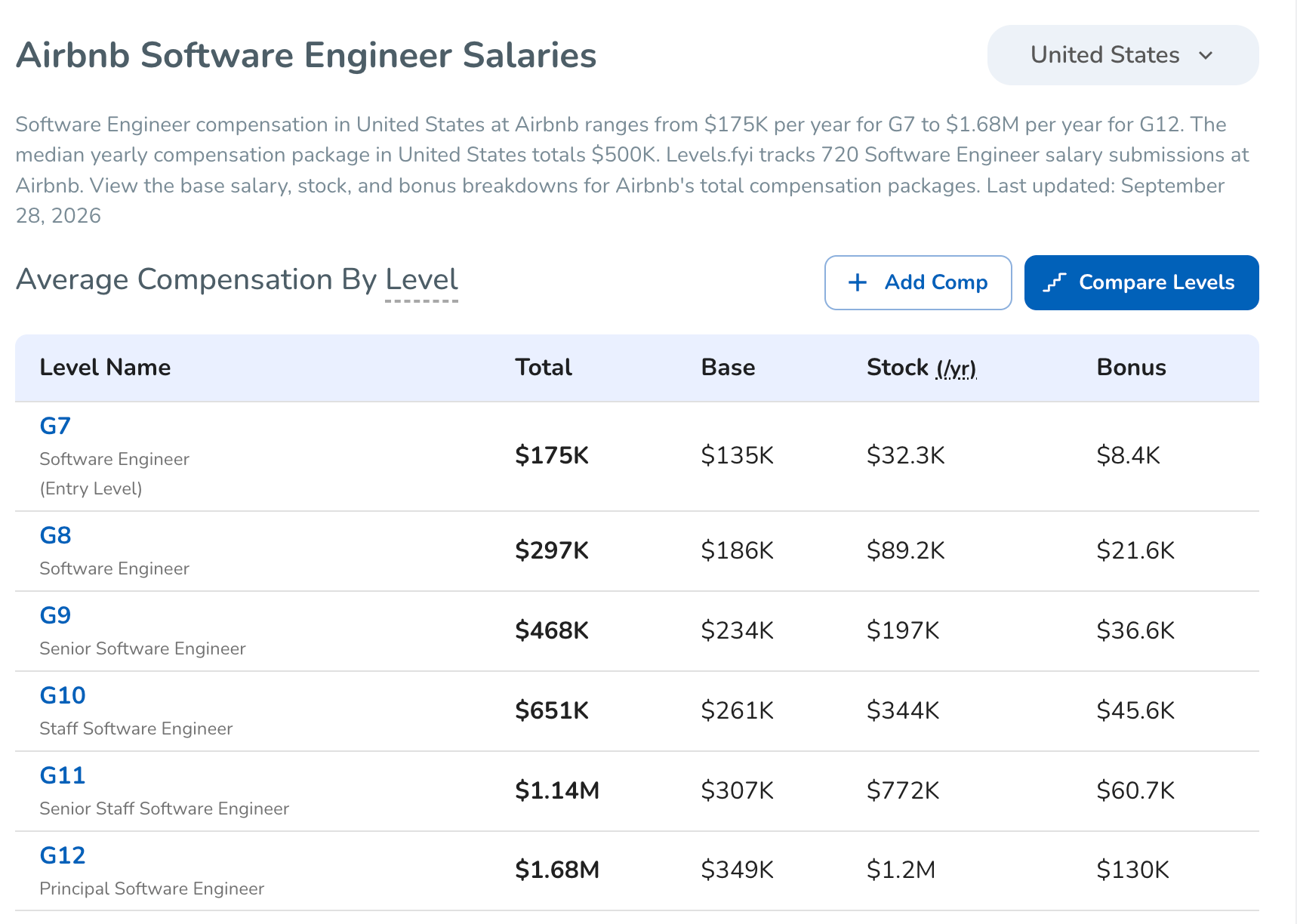
Staff engineer is the beginning of the “second” ladder in big tech. The ladder where you actually become incredibly rich and successful.
The first ladder goes junior (1-2 years) → mid level (1-2 years) → senior “terminal”
The second ladder goes staff (5-15 years)→ senior staff (∞ years) → principal
I went from senior data engineer at Netflix to staff data engineer at Airbnb in 2 years. This is 4 years faster than the average career trajectory.
I pulled this off by a combination of hard work, bravery, networking, leverage, and luck.
In this article, we will be talking about all the things that mattered (and didn’t matter) to achieve this speedup in career
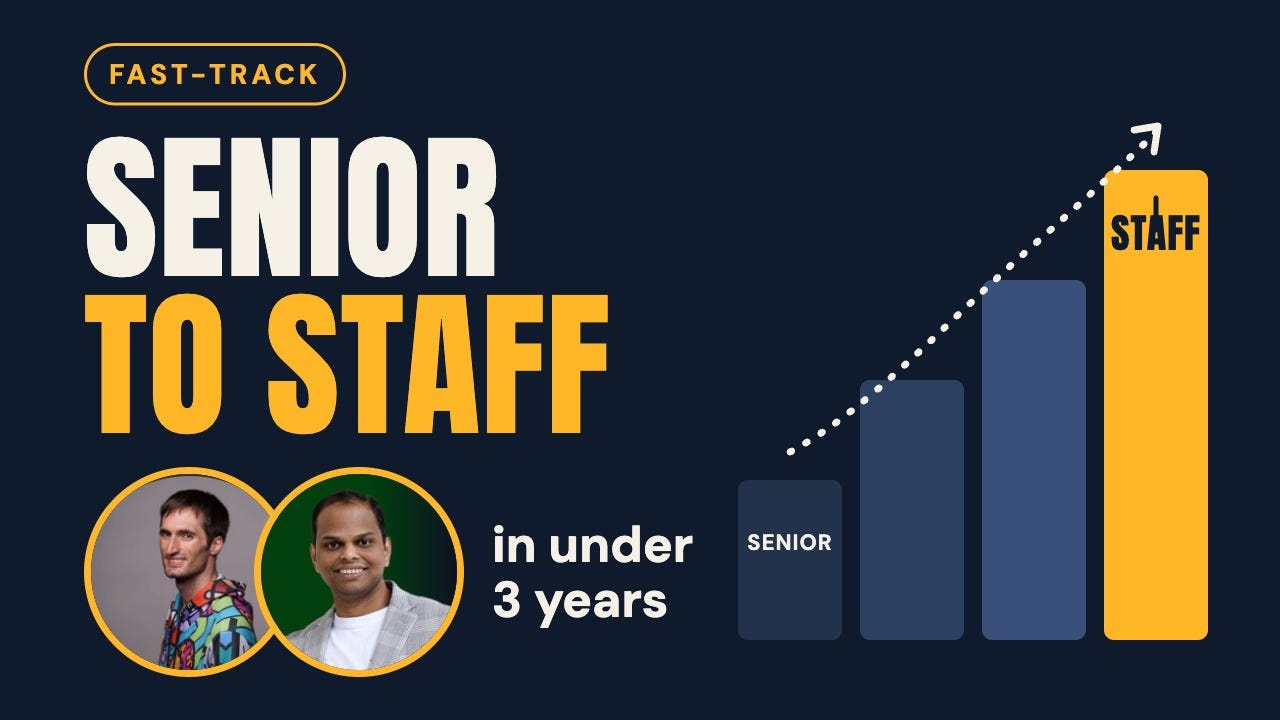
Prasad Rao and I are giving a free 1-hour webinar on more specific details of going from senior to staff on Wednesday, September 30th, at 9 AM PST. You can join here on YouTube.
Hard work is required, but hard work is not enough!
From 2014 to 2018, I spent almost every single weekend learning new tech skills and building 3 different startups that failed. These reps were critical in developing my skills in system design and product sense.
Without good system design, your products don’t scale. Without good product sense, nobody wants to use your products.
A lot of people want to worship hard work, but it’s only about 15-20% of the pie. It is a critical component, but it isn’t even 50% of the reason why I ultimately was able to speedrun staff engineer.
My dedication to hard work actually bit me in the ass in 2019 at Netflix. I was supposed to solve a hard problem by pushing back on overly aggressive timelines and telling them what was realistic. Instead, I accepted the timelines and ultimately burnt out from that role and hurt my progress quite a bit. I would be substantially richer right now if I had let the compound interest of my work at Netflix continue all the way to 2026.
Remember, becoming a principal engineer in big tech is a DECADES LONG journey. It’s very difficult to sprint the entire time through hard work. You have to get better!
Networking is more like friendship than transactions
When I was in Utah in 2014 and 2015, I had so many strong dreams of working at Google. I interviewed twice and got rejected twice. It was so painful for my 20-year-old self to accept. But I did understand a different fundamental truth back then, if I stayed in Utah, my network would not elevate me to a higher echelon. I would be capped at ~$150k if I never left my home state.
This realization made me desparate for finding new connections outside Utah. I became a LinkedIn all-star by filling out all the field in the profile. I sent 20-30 network DMs every day and also leveraging LinkedIn Premium to send out targeted DMs to prospective employees and mentors. I regret not going to more events but events felt local to Utah so I minimized their value even though their value was very high.
All of this grinding ultimately got me a big break in 2016 when Alyson Lyle called me up to interview at Facebook.
Many people then proceed to neglect their network once they are in a job because they don’t need anything from them. This behavior is why 90% of people suck at networking.
If you only think networking is necessary when you need something, replace the word networking with friendship and suddenly you’ll understand. If you only seek friendship when you need something you aren’t a good friend. If you only seek networking when you need something, you aren’t a good networker. If you change anything about your behavior from reading this article, this is the only thing that matters really.
Through this networking, I ended up meeting my mentor Jitender in 2016. He guided me on product sense and system design even further, and I owe a lot of my later entrepreneur success to him too.
If you aren’t leveraged, you’re losing
Hard work and networking are not sufficient. You have to do sufficiently cool shit to actually get to the next level. In big tech (and most of life), the only way to do cool shit is if you put effort towards projects and ideas that have a lot of leverage.
Leverage can happen in a few ways. Being close to revenue-impacting products, user-facing work, working on tools that get adoption, and managing / mentoring people.
The cool thing about leverage is: if you have a few different forms of leverage, you can run circles around the guy who is just working hard!
For example, managing people who build tools that improve revenue-impacting products. This is one reason why “I’m an engineering manager at Google who works on building internal tools for revenue forecasting” is such a meme.
Some of you are data engineers reading this and you’re like, how the hell do I do user-facing work? There’s a simple answer. Being upstream of machine learning models that are deployed in the app.
At Facebook, I worked on the datasets that fed the notifications machine learning model that made Facebook a lot more addictive. This allowed Facebook to show more ads to those addicted people and ultimately got me a promotion. As a data engineer, the data sets you create can be user-facing, but they often aren’t. If there isn’t any automated decision-making happening from your data sets, you might be in a slow-growing data engineering role and consider changing roles!
An ounce of bravery is worth a pound of begging for a promotion
Having a supportive manager is more correlated with a successful promotion than talent, innovation, and impact combined. We have all had at least one bad boss in our life and we understand the attack on your career is from a bunch of different angles!
First, the bad boss drains your energy. Second, the bad boss doesn’t give you the right opportunities. Third, the bad boss doesn’t advocate for your promotion.
If you have signals like this, it means it’s time to change companies and job hop! Job hopping is stressful because it is often a second full-time job to get a job. So be patient with yourself and try to timebox it! I have another article about the seven rules of job hopping here.
Before you job hop, make sure you have a good impact story about what you did at the company because that is something you’ll need for the rest of your life, potentially!
Doing everything right doesn’t mean you’ll be successful
This is the part successful people conveniently leave out. I got lucky. I got lucky that Alyson called me. I got lucky meeting mentors who invested in me. I got lucky getting projects with enough visibility and impact to accelerate my career. You can work hard, build an incredible network, and seek leverage and still get unlucky.
The trick isn’t pretending luck doesn’t exist. It’s increasing the number of opportunities where luck can find you. Hard work made me capable. Networking increased my surface area. Leverage made my work matter. Luck determined which doors actually opened.
Be kind to yourself. The world actually is deeply unfair. The outcomes you want sometimes are given to people less deserving than you. My mentor Alex Hormozi has a great quote: “volume negates luck.” The longer you stay in the game → more chances you have of great opportunities → the better the chance of getting extremely rich
This combination of hard work, networking, leverage, and luck is what took me from Senior Engineer at Netflix to Staff Engineer at Airbnb in 2 years.
Don’t just work harder!
Work hard on high-leverage problems, be brave, build relationships before you need them, and create as many opportunities as possible to get lucky.
We teach all of the necessary tech skills to become a staff engineer with hands-on projects and labs in the DataExpert.io academy! You can join here